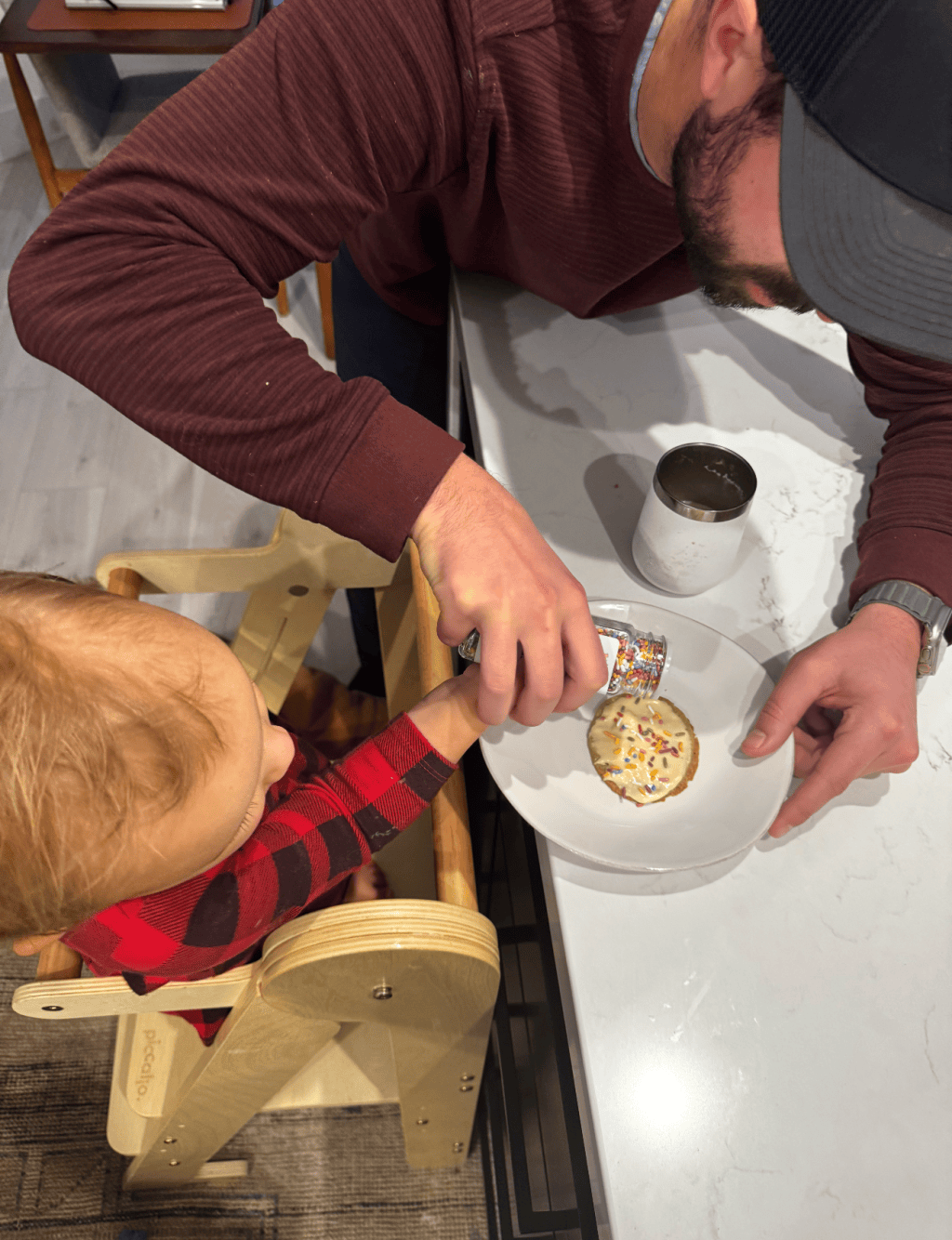
Every year I watch the toy catalogs start showing up in October and feel the same low hum of dread. Not because I don’t want my kids to have a great Christmas — I want that more than almost anything — but because somewhere along the way, “great Christmas” started meaning “biggest pile of presents,” and I don’t think that’s actually true.
Here’s what we’ve noticed in our house: the more gifts you go all-in on, the more gifts your kids come to expect the next year. It becomes a ladder you have to keep climbing, and somewhere in that climb, the actual point of the season — time together, and giving to other people — gets crowded out by the pile under the tree. So a few years ago we started doing Christmas differently. It’s not about deprivation. It’s about making room for the parts that actually stick.
For Every Gift, She Gives One Away
This is the piece that’s made the biggest difference for us, and it’s simple: for every toy Emery receives, she has to choose something of her own to give away. We take her to Goodwill or a donation center, and she picks it out herself.
I won’t pretend it’s always easy for her — three and four year olds get attached to things, and she has to sit with actually deciding what she’s outgrown or doesn’t play with anymore. But she also genuinely loves it. It sparks the funniest, most thoughtful conversations in the car — she’ll go through this whole process of remembering when she got something, whether she still plays with it, and land on “I think another kid needs this more than me right now.” Watching her use her imagination that way, thinking about someone else’s Christmas instead of just her own, is honestly one of my favorite parts of the whole season.
Teaching Her to Notice What Other People Need
Last year, Emery’s little brother Ellison had outgrown his shoes, and she was the one who clocked it — “Ellison needs new shoes.” So we took her with us to actually pick some out for him.
We do this in person, not online. Partly because shopping with a toddler on a screen just isn’t realistic, but also because it gives us a real reason to bundle everyone up and get out of the house during the stretch of winter when it’s too cold and gray to do much else — walking through the store, or the mall, looking at everything together. It turns an errand into an actual outing, and it means Emery is watching real shelves, real options, and thinking through an actual person’s actual need instead of picking from a screen.
That shift — from “what do I want” to “what does this specific person need” — is such a small ask of a preschooler, but it’s already changing how she thinks about gift-giving before she’s even old enough to have a “want” list of her own that’s gotten out of hand.
Even Santa Gives Back
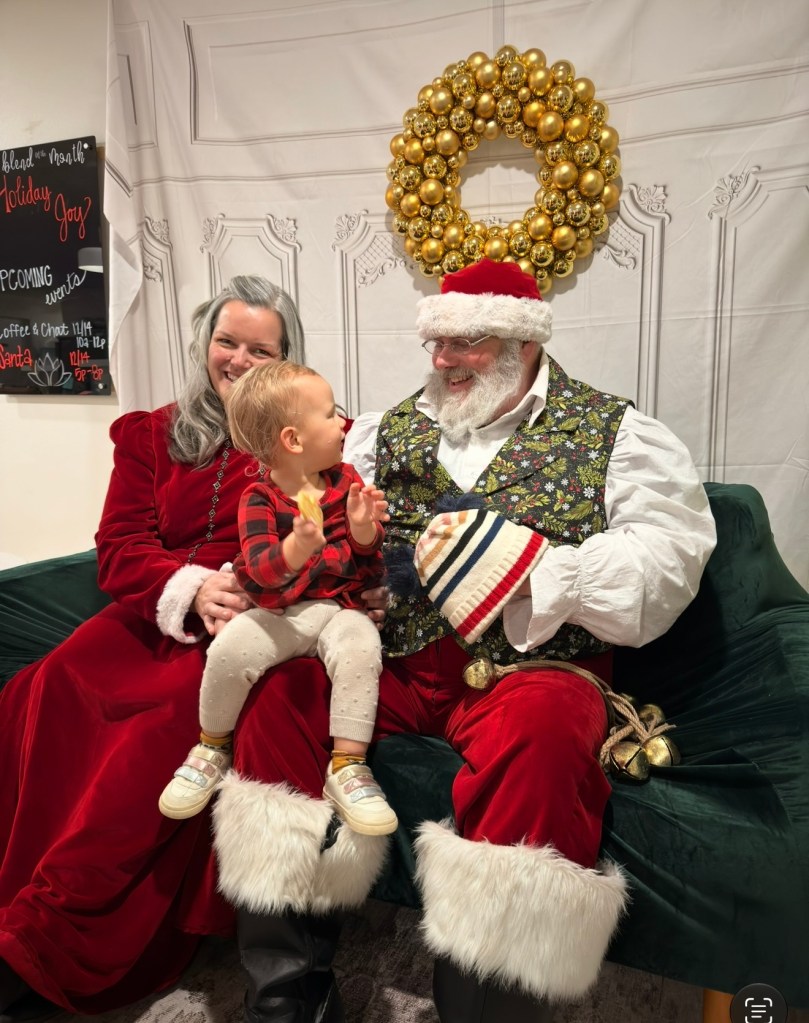
This part might be my favorite thing we’ve added. Before Christmas, we have Emery set aside three or four things she no longer needs in a pile. We tell her Santa will come pick them up when he drops off presents, and he’ll give them to kids who need them.
She absolutely lights up over this. It’s become part of her whole Santa mythology now — not just “Santa brings me things,” but “Santa also takes things from me to help other kids,” which somehow makes the magic bigger instead of smaller. If your kids are into the Santa tradition, I can’t recommend this enough as a way to fold giving into the parts of Christmas that already feel magical to them, instead of it feeling like a separate lecture about generosity.
Less Toys, More Play (The Pattern We Keep Seeing)
This isn’t a Christmas-specific thing for us, but it’s part of the same philosophy, so I wanted to mention it here: we rotate the girls’ toys year-round, keeping only a portion out at a time and swapping in “new” ones from storage every couple of weeks. What we’ve found, consistently, is that when everything is out at once, it’s overwhelming — they actually fight over toys more, and barely engage with any single one. When there’s less to choose from, they get so much more invested in what’s actually in front of them, and their imaginative play goes way up.
It’s the exact same principle we’re applying to gifts. Less isn’t a punishment — it’s what actually lets them engage more deeply with what they have. (I’ll do a full post just on how we run the toy rotation system soon, because it’s honestly one of the best changes we’ve made at home.)
Spreading It Out Instead of Piling It On
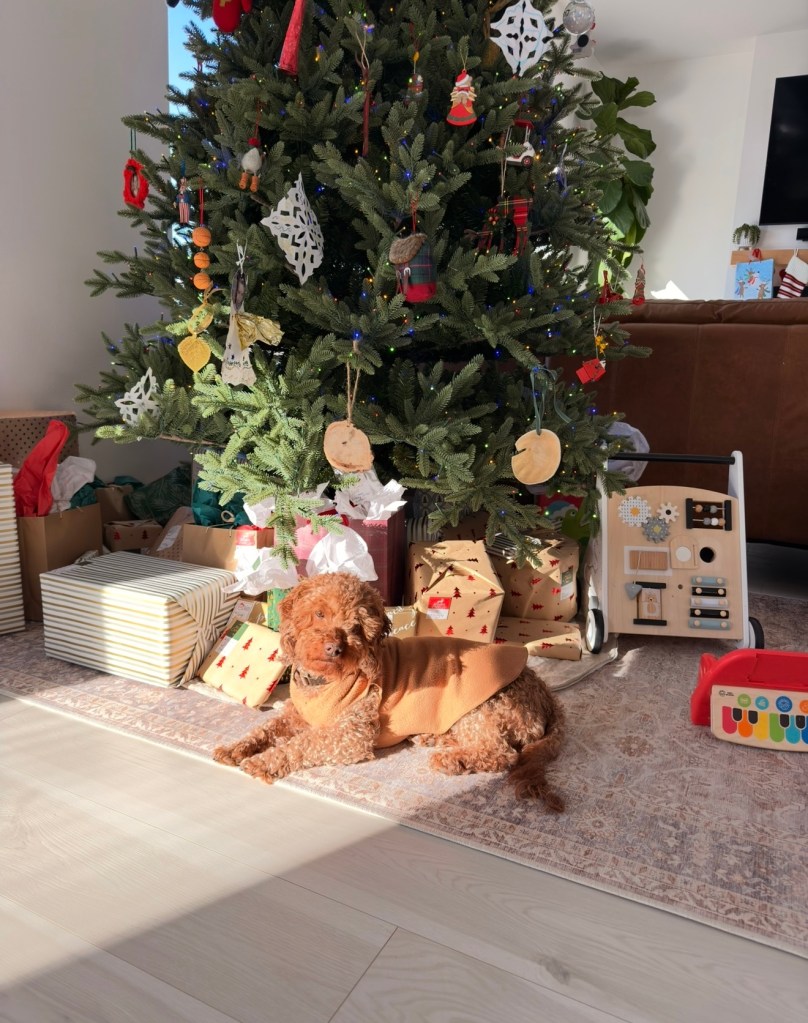
One more thing that’s helped with the overwhelm: we don’t do all the gifts at once. Gifts from my parents and Nolan’s parents happen a night or two before Christmas, sometimes even a week out. We do our own family gifts on Christmas Eve. And then Santa comes Christmas morning.
Splitting it up this way means there’s no single moment where the kids are buried under an avalanche of presents, overstimulated and not really absorbing any of it. Instead there are several smaller, calmer moments spread across a week or two, and each one gets to actually be enjoyed instead of blurring into the next.
What Actually Makes It Feel Magical

Take away the mountain of presents, and what’s left is honestly the stuff I remember most from my own childhood anyway: decorating the house together, driving around looking at everyone else’s lights and decorations, and — this is a big one in our house — “Where is Santa,” which Emery treats like the most important tracking mission of the season. None of that costs much, and none of it adds to the pile. It’s just presence, which turns out to be the actual point.
The Grandparent Problem (No One Warns You About)
I’ll be honest about this part, because I think a lot of parents trying to do less will relate: we ask both sets of grandparents to go easy on the gifts, and it just… doesn’t fully stick. Our kids are spoiled by their grandparents, plain and simple, and there’s not a lot we can do to control that piece of it. At some point we’ve had to let that be part of the deal — we can shape what happens in our own house, and we can’t fully control what happens at Grandma and Grandpa’s. We’ve decided that’s okay. It’s part of the fun of being a grandkid, even if it runs a little against our own approach.
It Doesn’t Have to Be Perfect to Work
We’re not doing this flawlessly — between grandparents and our own soft spots, our kids probably end up with more than we set out to give them most years. But the parts we can control — the giving-back exercise, the in-person shopping trips, Santa’s own version of generosity, spreading things out instead of piling them on — those are the parts actually shaping how Emery thinks about gifts, other people, and what the season is even for. That’s the whole goal. Not a smaller Christmas for its own sake, just one with more room in it for the things that actually matter.
— Kelsey
P.S. If you’re craving more of this kind of simple, intentional living all year — not just at Christmas — grab our free Joy-Filled Home Guide. It’s full of small shifts like these that make a bigger difference than you’d expect.


Leave a comment