There was a version of our house where every toy we owned was out at once — and it was loud in a way that had nothing to do with noise. Nothing got played with for more than five minutes before it got dropped for the next thing, and by 10am the floor looked like something had exploded in it. We didn’t know it yet, but that was too much choice, not too little discipline.
Toy rotation fixed it, but not in the tidy, color-coded-bins way it usually gets talked about. Here’s what it actually looks like at our house with a 3.5-year-old and a 16-month-old.
We Don’t Rotate on a Schedule — We Rotate When the House Tells Us To
We used to think rotation meant picking a day, like every other Sunday, and swapping things out whether they needed it or not. We don’t do that anymore. Instead we watch for two signs: the kids start playing with each toy for a much shorter stretch before moving on, and the floor goes from “toys out” to what we call full scatter — genuinely looks like something detonated in the living room. That combination is the tell. It usually lands around the two-week mark, but we don’t force it to a calendar; we let them tell us when they’re done.
The other thing we’ve noticed: when the current rotation is working, the house actually stays cleaner. Not because we’re cleaning more, but because they’re picking one thing and staying with it instead of pulling out, abandoning, and grabbing the next thing in under a minute. A calm floor is basically a sign the rotation is doing its job.
Everything Rotates Together — Not Split by Kid
We don’t run a separate system for Emery and Ellison. Everything goes in and out at once, which means a 16-month-old ends up with access to “big kid” toys and a 3.5-year-old ends up back with things that were technically Ellison’s first. You’d think that would be chaos. It’s actually the opposite — Emery will sit down with something from the baby side and Ellison gets pulled into whatever Emery’s doing with something that’s technically “his.” We didn’t plan that part, but we’ve come to think it’s one of the better side effects of not overthinking the split.
Not Everything Actually Leaves — Some Toys Just Change Location
A couple of our favorites don’t go in a bin at all, they just move. The Pikler Triangle basically never gets put away — but we do move it between upstairs and downstairs to make a new “play spot” out of the same toy. It’s the exact same climbing set, but because it’s suddenly in a different room, it reads as new to them. Zero cost, same effect as buying something new.
p>
The Magnitales Easel works the opposite way — we actually do put that one away sometimes, specifically because if it’s out all the time they stop noticing it’s there. Pull it back out after a stretch of being tucked away and it might as well be Christmas morning. Both tricks get us the “new toy” feeling without spending a dollar on an actual new toy.
How We Keep It From Looking Like a Storage Problem
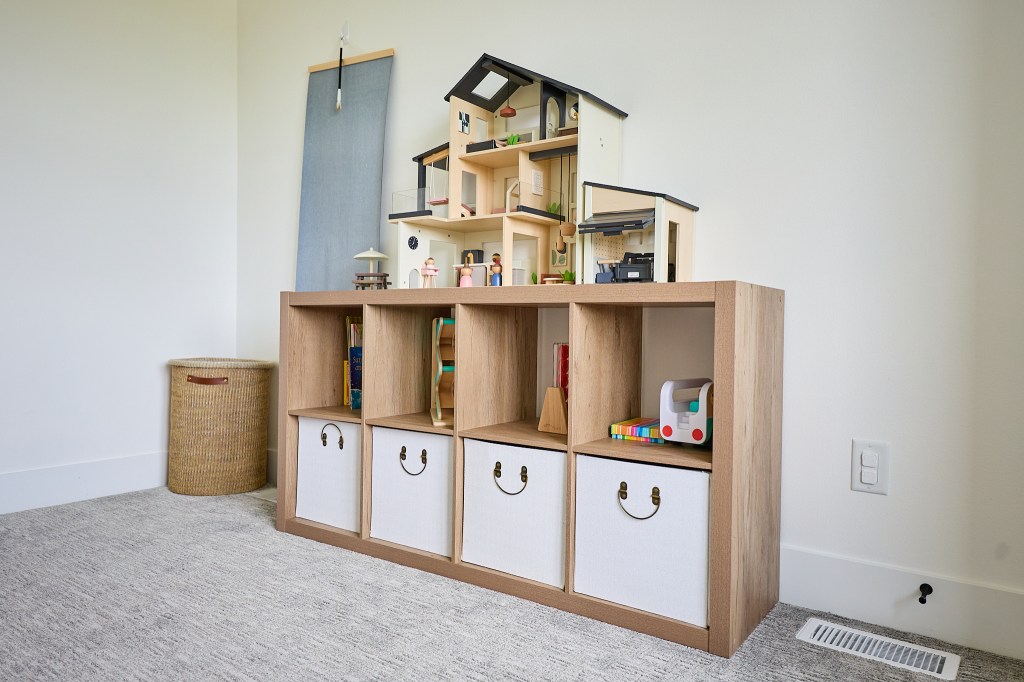
This is honestly the piece that made rotation sustainable for us, not just a good idea we gave up on: two cube storage shelves, one in the living room and one in the playroom. The bottom cubes have baskets that go in front, so whatever’s inside is out of sight — but the kids still know exactly where everything lives, which keeps the house looking calm even with two little kids generating chaos daily. The open cubes on top are for the one or two things we want within easy reach at any given moment, so it still looks intentional instead of like a toy store shelf. This is the exact style we use — it’s been one of the best purchases for keeping this whole system actually working instead of just being a nice idea on Pinterest. These are the bins we use in the baskets — the shelf itself comes with the frame, but these are the ones that actually fit right and keep things from just sliding around loose behind the baskets.
The rest of what’s off-rotation lives in closets and bins in spots the kids don’t have access to — not because we’re hiding anything dramatic, just so they’re not digging through the “off” toys and pulling the whole system apart on their own. A swap itself doesn’t take long once the shelves are set up right — it’s mostly just moving what’s in the open cubes and the front baskets, not reorganizing the whole room.
What Actually Changed Once We Did This Right
The difference in how long they’ll actually play with something is not subtle. A toy that had been completely ignored for weeks, the second it goes on a break and comes back into rotation, gets treated like it just arrived in the house. They notice things about a toy the second time around that they never noticed the first time — like it’s genuinely new information to them that it does something else, even though nothing about it changed except that it left for a while.
What We Got Wrong the First Time
Want a simple way to actually keep this going? Grab our free Toy Rotation Starter Kit — a two-page printable with the “is it time to rotate?” checklist plus a fill-in bin tracker you can tape inside a closet door. Download it here.
Our first attempt at this didn’t work, and it wasn’t because rotation itself is a bad idea — it’s because we didn’t actually reduce what was out. We were rotating things in without ever really taking enough out, so it still felt like a mountain of toys and a ton of upkeep, and predictably, we didn’t stick with it. The fix was almost embarrassingly simple: put more away, leave less out. Fewer toys out at once forces more imagination and gets us longer, more focused play — and we only found that out by accident, after the “half-hearted” version failed first.
This post contains affiliate links — if you shop through them, we may earn a small commission at no extra cost to you. Full disclosure here.


Leave a comment